Outcome of FEFAC-BFA-Nevedi Circular Feed Symposium at VICTAM International
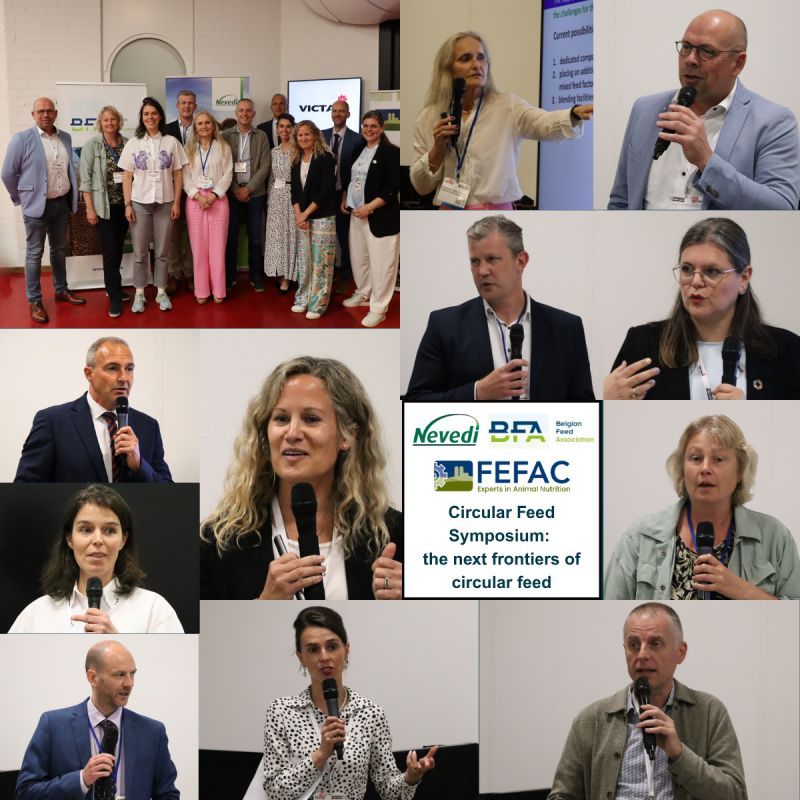
The next frontiers of circular feed
The European feed industry has long been at the forefront of circular feed, making effective use of co-products and by-products from the circular economy to improve sustainability and resource efficiency. As livestock production faces increasing political and societal pressure to address sustainability challenges, the feed sector must continue to innovate and scale circular solutions responsibly.
At the Circular Feed Symposium “The next frontiers of circular feed” during VICTAM International in Utrecht – organised by FEFAC, BFA and Nevedi and moderated by Anton van den Brink (FEFAC) – the potential of circular feed once again became clear. At the same time, further scaling requires the right enabling conditions. The European feed industry has a strong track record in valorising co-products and by-products. However, further scale-up strongly depends on the interaction between innovation, market dynamics and regulatory frameworks.
From foundations to application
Sam De Campeneere (ILVO) showed that innovation starts with robust scientific foundations and testing facilities. These are essential to validate new feed solutions and scale them responsibly.
Unlocking the full value of residual streams
Alexander Romme highlighted that former foodstuffs already make a substantial contribution, amounting to around 5 million tonnes per year. The challenge lies in further valorisation, particularly in a context of competing applications and regulatory constraints.
Enabling conditions for circularity
Carine van Vuure (EFPRA) made clear that rendering is a proven circular model. At the same time, regulation – particularly regarding processed animal proteins (PAPs) – limits further application. This underlines the importance of risk-based and proportionate regulation.
Innovation is accelerating
Stef Denayer, Nele Ameloot and Eleni Ntokou demonstrated how rapidly new protein pathways – such as fermentation and single-cell proteins – are scaling towards industrial applications.
Opening up new streams
Contributions from Clazien de Vos-de Jong (WUR) and Sara Stiernström (EasyMining) showed that new residual streams, such as catering waste and phosphate recovery from sewage sludge, offer opportunities worth discussing. As regards catering waste, the possible presence of animal by-products is the key point of attention. Although research shows that the risks are very low, the spread of infectious animal diseases can never be fully ruled out.
Key takeaway
The technology is developing rapidly. Raw materials are available. The main challenge is not technical feasibility, but creating the right conditions for scale-up.
Further development of circular feed in Europe requires:
- more risk-based regulation
- better valorisation of residual streams compared with competing markets, including energy
- the creation of scale
Only then can the full potential of circular feed be unlocked.